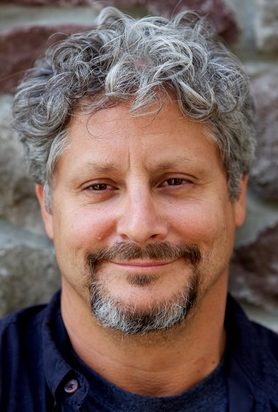
By Victor Greto
A good relationship is a work of art, says Joe Brady.
“You can make any relationship go if you have the desire and energy to have one,” he says. “You work at it to get a finished product: a masterpiece.”
Tom Gehling, his partner of 30 years, is more matter-of-fact as to how they’ve survived. “Compromise,” he says simply, and smiles.
Tom and Joe, both 55, own the Hide and Seek Complex of five bars and restaurants on West Colorado Avenue. They opened up the Hide and Seek Inn 27 years ago. That’s also part of the secret of their relationship.
“We get along because we work 14 hours a day and live together,” Joe says. “You become closer to each other. You have to be alike in some ways. And be well-adjusted people.”
They seemed to have always known they wanted to be together. They moved in with each other only three months, after meeting at a gay bar called “Exit 21” on the west side.
“It’s been OK except for the prejudice you get,” Joe says of the 30 years. “You have to control yourself in public. No kissing or hugging. You have that always in your head.”
Joe seems to have been the driving force behind the business. “I kind of always wanted to be a bar guy,” he says. “I watched the old black and white movies when I was young, movies with the speakeasies. That was always in my mind.”
Tom, on the other hand, wanted to be a writer. He both edited and contributed to a quarterly magazine in the late ’70s called “Colorado Gay.” But he stopped, he says, because the bar took up most of his time. And because, at the time, it wasn’t easy getting submissions.
“The ’70s were bad (for gays in Colorado Springs),” Tom says. “When we opened the bar, there was a lot of harassment, from the police and people who didn’t understand gays. We knew of beatings and gay-bashing.”
Times have changed. They consider themselves as “mainstream” as any heterosexual couple.
In fact, their relationship has coincided with an increasingly better climate for gays nationally. It’s also been 30 years since the Stonewall riots, when patrons of a gay bar in Greenwich Village fought back against a police raid. This incident is almost universally considered a turning point for gay rights,
Back then, Joe says, “there were extremes in the gay community. People went into disguise to cover up. It went into a party atmosphere, a carnival atmosphere. The public kind of expected it. Prior to AIDs, that was the atmosphere of the gay clubs.”
Since the 1980s, Joe says, “we’re more center of the road because the times have changed. Gays have developed more political clout, become more responsible citizens, demanding and getting more.”
For both Joe and Tom, Amendment 2, Colorado’s 1992 anti-gay rights measure that was eventually ruled unconstitutional by the U.S. Supreme Court, reflected both the state’s and the city’s minority vocal conservative element. “The flip side of that,” Joe says, “is more supportive groups that wouldn’t have been there, like Citizens Project.”
Tom says he’s noticed no important difference between his relationship with Joe and his siblings’ marriages.
“We pretty much paralleled their relationships except for sexual preference,” he says. “It is the same.”
Tom says he recalls no major obstacles. “We didn’t let it get to that point.”
“It’s always been easy to communicate and express our feelings. We can almost read each other’s minds,” Joe says.
Joe and Tom are not an anomaly.
Rod Fleming and John Hilde, who have been together for 13 years, also happened to have met at the same gay bar where Joe and Tom met years earlier, and also moved in together after only three months.
But there the parallel ends.
While according to Tom and Joe, their immediate families did not have a problem with their relationship, John’s did.
And it happened at perhaps the worst time in John’s life.
He had been living with Rod only a short time when he barely survived a car accident. He was in the hospital for three months.
“After John was out of the woods, everything came to a head,” Rod says. “(John’s parents) didn’t want to be there when I was there. Some of the anger (they felt) about the accident was coming out at me. I gave them the space they needed, but told them that I would be there – John was not going to be left alone.”
Even after John got out of the hospital, his parents refused to visit both of them. Then, John says, “my dad called and wanted to come up for the balloon classic and go to breakfast. I would have said no, but Rod happened to be there when I got the call, and he said yes.”
John’s parents spent the night, saw the balloons and had breakfast. After that, John’s father worked with Rod helping repair the old house they bought on the west side in 1993. But Rod and John’s relationship was never mentioned until years later, after John’s father died.
“My mom after dad passed, said, ‘Rod will always be there for you.'” John says.
The accident also helped John come to terms with his homosexuality, he says. Three months in bed will do that. He was also diagnosed with the HIV virus, and then with AIDS nearly a decade later. After a time when he weighed just over 100 pounds, he’s feeling much better and has gained a lot of weight back.
“The illness strengthened our relationship,” Rod, 44, says. “It helps put things in perspective. You can let go of the little stuff.”
John says becoming comfortable with his homosexuality took both time and personal struggle.
“It’s a lot on how you present yourself.” he says. “I had a hard time. I was asked to leave a bible college because of homosexuality. It took 10 years for me to go back to church. I had to deal with it or throw a part of my life out. We’re still dealing with that today.”
John, 40, is finishing a one-year internship in Denver with the Universal Fellowship of Metropolitan Community Church, a church founded 31 years ago in Los Angeles for gays and lesbians.
Rod says he feels he is part of the mainstream, “both external and internal. Gay people need to look within themselves and grasp their good qualities and reach their potential. It’s easy to get a bad image of yourself. It can be crippling.”
People also are starting to realize, John says, “that you can’t separate sexuality from spirituality.”
Rod says he understands the progress of gays into the mainstream as a “wheel effect”: “The more (gays) came out, the more contact (society) has, the more stereotypes disappear; the more accepting society is, the more people come out.”
But most of their day-to-day attention is centered on each other.
It’s all about trust and respect, John says.
“We allow for each other’s different interests and growth,” Rod says. “Like John’s call to a ministry. I’m completely supportive.”
Even as you change and grow as individuals, that doesn’t mean the relationship has to end, Rod says. “You don’t grow apart. You become a part of what’s happening.”