By Victor Greto
She looked winded when she entered the room.
But Kim Bishel, 36, dressed in a running suit and tennis shoes, was breathing evenly as she sat down at a long table in the Helen F. Graham Cancer Center on the campus of Christiana Hospital. Her hand occasionally traced the pointed strands of her dark, thin hair.
“I am really tired,” she says. “But I still haven’t let it change my life.”
Sitting next to her, Dave Bishel, a 43-year-old ex-Marine, agrees with his wife. “We take it for granted she’s going to be OK,” he says of himself and his two children, Aubrie, 14, and Tyler, 11.
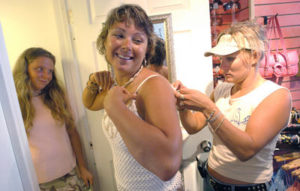
If some of the routine of Kim Bishel’s life with her husband and children and friends hasn’t changed since she was diagnosed with breast cancer 10 months ago, she most definitely has.
As have the lives of the thousands of Delawareans who suffer from breast cancer, including Cheryl Wesley, Julie Ann Turner and Donna Grazal, all of whom continue to struggle with the disease.
Each continues to live her life as much as possible the way it was before diagnosis, supported by a web of family and friends and support groups.
But they have changed. Fighting for your life will do that to you.
According to the American Cancer Society, 3,800 people have breast cancer in Delaware, and 120 probably will die this year from the disease. Last year, 700 new cases were diagnosed in the state and 130 died from it. Nationwide, nearly 213,000 people have the disease, and more than 40,000 died last year from its effects.
****
When Kim Bishel’s thin mouth smiles, it’s the expression of a person who knows things you don’t. There is a curious beauty to her demeanor, a battle-weary wisdom that seems nearly at peace with the ever-present possibility of the disease’s recurrence, and even death.
Her new perspective and maturity happened fast.
Last April, she walked 39 miles in two days at the Avon Walk for Breast Cancer in Washington, D.C., and raised $1,800 for the cause. In perfect shape herself, she did the walk for the friend of a friend.
Two weeks after that, she was diagnosed with breast cancer.
She had felt a pea-sized lump at the top of her right breast a week before the walk, but didn’t think much of it. She had had breast implants put in the summer before. After the walk, some doctors told her not to worry about the lump, while others urged her to get a biopsy. Five days after her biopsy, as the lump grew to the size of a golf ball, she was diagnosed with breast cancer.
This week, she begins to gear up to be in shape for the walk again, scheduled for the weekend of April 30-May 1.
It will not be easy.
After the diagnosis, Bishel learned she had two types of breast cancer, one centered in the lymph nodes of the breast, which are set toward the back of the breast and can infect other parts of the body; and another centered in her breast’s lobes, which contain groups of small glands that produce milk. The latter required a mastectomy.
Shortly after she had her right breast removed, she decided to have her left breast removed. It was not an easy decision. But she was determined.
“I wanted it off,” she says. “I didn’t want to go through it all again. The chances were pretty high that I would get it there, too.”
Aside from her breasts, Bishel has lost her hair, gained 20 pounds, and gone through bouts of chemotherapy and radiation; the former causes persistent fatigue and nausea, and the latter occasionally causes 3rd-degree burns.
Because her cancer is exacerbated by her hormones, she takes medication that fools with her body’s production of estrogen. Its side-effects have given her a vision of one aspect of her future: menopausal symptoms, including hot flashes and restless, often sleepless nights.
Only minutes before she walked into the room, she took one of the last radiation treatments she hopes she’ll ever have to go through.
Like a soldier who has lived through several tours of duty, she looks both weary and relieved. “It’s a good thing,” she says paradoxically of her situation. “I know I’m not going to give up.”
****
Breast cancer never goes away.
Even when there’s no sign of it, after chemotherapy and surgeries, says Cheryl Wesley, 35. She has had a lumpectomy, weeks of chemotherapy and, finally, a mastectomy of her right breast. She also has had a lumpectomy performed on her left breast, but the lump there was found to be benign. She was diagnosed less than three years ago.
“The longer you go without a recurrence, the better you feel,” the Middletown mother of three says. “You try not to talk about it so much with your family, but internally you still think: ‘Am I going to die from this? Will it kill me?’”
As with Bishel, that nagging fear shaped her decision to get a mastectomy instead of enduring more radiation treatments.
“I wasn’t concerned about breast preservation,” she says. “Once you have cancer, that’s the least of your concerns. You want to do everything in your power to control a recurrence. I would have been willing to sacrifice both.”
Directly after the mastectomy, she had a “tram flap” done. To do the “trans-rectus abdominis muscle flap,” a surgeon removes skin and fat from the abdomen to reconstruct the breast, also sculpting the skin to resemble a nipple.
A bonus of the procedure, Wesley says, was a tummy tuck. Even so, the tram flap has required more nips and tucks and aesthetic surgeries than the treatment of the cancer: when it was first done, it developed a blood clot that had to cleared through the application of leeches.
Aside from the physical pain and discomfort, there also are psychological effects of treating breast cancer.
“From the female point of view, you feel you’re not pretty enough,” she says. “A breast that has no feeling, no sensation — you don’t want to be touched there.”
That feeling is exacerbated when you lose your hair, she says. “But you get through that with a supportive husband who doesn’t treat you any different.”
It also is hard on her children, especially her 5-year-old daughter, Hunter, who panicked when Wesley’s hair began to fall out. The child has fixated on God and death ever since, she says.
Last June, Wesley had a lumpectomy on her left breast. That means more scars, and her child seeing her mother come out of the shower affects her profoundly.
“I was really careful when I was diagnosed,” she says about telling her children. “I told them that people can die of cancer but I would do everything in my power not to leave them.”
Like Wesley, Bishel says she aggressively treated her cancer in part because of her children. But once her hair fell out, the persistence of fatigue after chemotherapy, her gaze into the mirror began to take its toll. Among other mixed emotions, she began to resent the stoicism of her husband.
The “piddling fights” went away — no more arguments about who’s taking the dog or the trash out. “But a big thing is I may not feel he’s always there,” she says.
“I’ve never been the emotional type,” Dave Bishel says.
****
Diana Dickson-Whitmer has been treating breast cancer patients for more than two decades. At Christiana Care, she diagnoses breast cancer for two to three patients a week. That takes its toll, but so does telling the patient that she doesn’t have cancer, which happens five times more often.
“I love what I do,” she says. “Most of the time the answer is there’s not a cancer.”
To see the pain on the faces of those who need to be told is difficult, she says.
It’s a horror for the patient, especially when she is alone and making plans for a wedding.
At 30, Julie Ann Turner found out she had breast cancer when she was alone: her surgeon had called her up with the results of the biopsy.
“All I honestly remember is being scared and crying,” she says. “Nausea. Absolute fear. What did I do to deserve it?”
She further learned the cancer found in her right breast had formed in the milk ducts, and wasn’t confined to one area; she had to have a mastectomy, followed by chemotherapy treatments.
It was May of 2000. She was to be married in September. “We talked about postponing the wedding,” she says. “But I said I don’t want to be bald and have one breast for my wedding.”
Her fiancée, Markquis, finagled the changes. They were married by a justice of the peace, and spent four days in the Bahamas on their honeymoon. The day after they returned, the day after her 31st birthday, Turner had a mastectomy.
After chemotherapy began, she lost her hair, her long, light brown hair. She cried inconsolably. But her husband and his friend both shaved their heads in support.
Even with the support, at times Turner would not speak to her husband, and was prescribed anti-depressant medication. Like Bishel, she took drugs that gave her menopausal symptoms, and then took another drug to eliminate those symptoms.
After the mastectomy, she had a breast implant. Because of its smaller, perkier shape, she had her other breast reconstructed.
“It’s the new me, a different me,” she says. “I have a lot of scarring. I have little to no sensation in the skin over the implant. Part of my sexuality went away in that area.”
But it’s OK, she says. “I’m more feminine now than before I got sick.”
She likes pretty clothes and high heel shoes, she says. She’s nurturing, and she plans on working on having a child in the next few months, five years out from her diagnosis.
Wearing a snug-fitting, white ribbed sweater in the conference room where she works, she says, “You’d never know it, would you?”
“That piece of flesh is not about what makes me a woman,” she says. “And I’m here to tell about it.”
****
More often than not, doctors and surgeons do not delve into the psychological effects breast removal and cancer have on most patients, including their sex lives, Dickson-Whitmer says.
One patient whom the doctor had been treating and following for 12 years, had a recurrence of cancer. The patient had had a successful tram flap reconstruction six years earlier, and Dickson-Whitmer assumed that everything was working well.
“In the course of talking to her about her options,” she says, “I discovered her husband had not slept with her since six years before, when she had the mastectomy and reconstruction.” She had seen her often over the years, “and I didn’t know that, and didn’t ask. I was horrified.”
The psychological impacts of breast cancer sometimes begin even before diagnosis.
When Donna Grazal was 18, her mother, 46, died of breast cancer.
Last year, Grazal turned 46 and was fighting her own breast cancer that had been diagnosed nearly a decade before, and has recurred three times since. As importantly, like herself nearly three decades ago, her daughter turned 18 the same year Grazal turned 46.
“Last year was a tough year for me,” she says. “I have three kids, my mother had three kids. We were both young mothers who didn’t put our health first. The parallels were frightening.”
As a young nursing student, it took Grazal years to get over her mother’s death.
When she was diagnosed 10 years ago, she was living in England with her husband and three small children. But the pain of her mother’s death lingered so much that she did not tell her father she had cancer when he visited her family.
But, when she began treatment a month later, she told her father the news over the phone.
“He dropped the phone and started crying,” she says. “I never saw him again.” He died a few months later.
His funeral was a turning point in her life. Unlike what her mother did, Grazal resolved to put her health first, before her husband, even her kids. “I’ve learned to take better care and think of myself first,” she says. “If I don’t, I won’t be here for my family.”
It has made a difference.
She has been getting chemotherapy for two years now. Since her diagnosis a decade ago, she has endured a lumpectomy (where the cancer and tissue around it is removed but not the whole breast) and survived three recurrences of the disease in her lymph nodes. She must treat it continuously with chemotherapy so it does not become worse.
Although she has not had a mastectomy, one large tumor she had removed caused permanent damage to her right arm and hand. Tumors recur, so she needs chemotherapy regularly.
“My life is so full of doctor appointments and CAT scans and I get so sick of that,” Grazal says. “I joke about it, but I feel my body is 20 years older than it is. I can live, but there are times when there’s not a lot of things to laugh about.”
One doctor told Grazal she was like a vine that needs frequent pruning, she says.
But like that pruned vine, that means she looks great.
“I look fantastic in my wig,” she says. “I’m just this wonder woman. If you saw me you’d never know there are serious problems going on with me.”
Bishel Takes The Avon Breast Cancer Walk
WASHINGTON, D.C. — At a little more than two miles into the rain-soaked first day of the 39.3-mile Avon Breast Cancer walk Saturday morning, Kim Bishel stopped in front of the Natural History Museum on Constitution Avenue to take off her left shoe.
On a foot cluttered with a dozen oval bandages, she added one more around the tip of her second toe: it was uncomfortably rubbing against the big toe. “My feet aren’t that good,” she said.
But her determination is.
Bishel, 36, who first made the walk last year in memory of her grandmother-in-law who died from the disease, was making the walk for herself this year.
Two weeks after she finished last year’s grueling walk, she was diagnosed with breast cancer. Like hundreds of those walking with her, in less than a year she became a “survivor,” having had both breasts removed, endured radiation treatments and taken several medications that negatively affected her body.
She joined about 2,200 others from across the country who gathered by 6 a.m. at L’Enfant Plaza to participate in a two-day walk to raise thousands of dollars for breast cancer research.
Bishel’s attitude at just about everything in her life has changed in a year. Even in the rain, before the walk began, she fretted that she would “look like a drowned rat” within 20 minutes.
But she quickly smiled. “After everything I’ve been through, what’s a little rain? It’ll keep us cool.”
****
The emotional and psychological cost of having breast cancer can be devastating. But with acceptance of their condition often comes a renewed gusto for life, doctors and patients say. Empathetic discussions with others who have cancer, helping others through the same situation and focusing on the positives of daily living help, they say.
“There has to be a way for cancer patients to take control back into their lives,” said Jeff Kendall, a health psychologist at Christiana Care’s Helen F. Graham Cancer Center, who talks to dozens of cancer patients each week.
Each case is different, he stressed. But for many, their plight “pulls at an altruistic feeling,” he said. “They have a need to help those coming after them, through fund-raising walks, awareness programs and through volunteering.”
That includes activities such as the Avon Breast Cancer Walk, which raised $5.2 million last year.
The walk is so important to Bishel, that two weeks ago she postponed a surgery to finish the reconstruction of one of her breasts.
When she made the appointment for her surgery, she knew it was less than two weeks before the walk. “But I wanted everything to be done,” she explained.
A week before the surgery, however, she decided she didn’t want the “double stress” of recovering, and walking up to 40 miles a week to prepare for the walk.
“I feel it,” she said. “I’m not as strong as I was last year.” Although plagued by back pain, she worked hard to prepare.
“It has a special meaning to me,” she said. “It’s going to be emotional when I do it for myself this year.”
After the walk, she wants to talk to others who have cancer. “I need that,” she said. “You just can’t talk to friends and family about some things. You have to talk to someone who’s been there.”
****
There are several stages of reacting to the news that one has breast cancer, Kendall said.
Those stages include the shock and fear at the time of diagnosis, and the transition into negative emotions, from anxiety to depression and fatigue. A health psychologist works on each of these emotional stages, he said, trying to instill within patients a “realistic optimism,” by help to develop coping skills.
“You have to get them out of it by giving valid, reliable information, and get them to refocus on their strengths,” Kendall said. “Shock is the perception that what they’re facing is greater than their ability to cope with it.”
Cindy Dwyer, 59, went from waking up in the middle of the night in a cold sweat thinking about death to believing without hesitation that breast cancer “was the best thing that ever happened to me.”
This 14-year evolution occurred despite a mastectomy and the cancer’s recurrence.
“It changed me for the better,” said Dwyer, executive director of the Wellness Community Center of Delaware in Wilmington. “I value every day of my life.”
Diagnosis started her on a long road.
“I never died before, so I didn’t know how to do it,” she said. “I planned my own funeral, wrote my obituary. I thought for sure I was going to die.” Questions of “Is it terminal,” didn’t help, either.
She went through an “I hate God stage,” and would sink into the cushions of her living room couch and stare into space for minutes at a time.
Hope stirred from an unlikely place: the grocery store.
“People there were as mean to me as ever,” Dwyer said. They rudely reached past her, hit her cart with their carts. “It was like before I had heard I had breast cancer.”
Over time, talking to others who had cancer helped nudge her out of depression, she said.
To go from a state of shock and despair to expressing that one is better for having cancer is not unusual, Kendall said.
“The majority of women with breast cancer view their lives differently after the cancer treatment,” he said. “But they view it in a positive way. It’s a wake up call.”
A big part of making one emotionally healthy is anything that can make a person feel more in control of her life, said Sean Hebbel, program director at Wellness.
“Isolation is a common feeling after being diagnosed,” he said. “It’s good to talk to someone else who has heard those words, ‘You have cancer.’ It’s like a club that no one wants to join.”
Dwyer said it’s not about illusion: it’s about living day to day, because the threat of cancer always exists.
Even after she had beaten off her cancer twice over the course of 13 years, she found herself face to face with her ailment’s power when she returned to the hospital for tests that had nothing to do with breast cancer.
Standing at the entrance of the room where she was to be examined, her legs gave out. The look, the smells, the touch of the hospital knocked her down. “I underestimated that feeling,” she said. “I won’t do that again.”
****
Beth Schnitman-Malm is cancer free after 14 years of treatment and one recurrence. She has no illusions about her experience, but she can’t help but be optimistic.
She survived two lumpectomies, chemotherapy and radiation therapy, including a five-year regimen of drugs completed only weeks ago.
But her knowledge of breast cancer doesn’t stop at herself. Her mother fought breast cancer for 18 years before dying from lung cancer. Her aunt and first cousin both died of breast cancer. Her father died of pancreatic cancer.
Most recently, her younger sister Heidi was diagnosed with breast cancer, and is now in the middle of eight chemotherapy treatments after having a mastectomy late last year.
“My sister always looked up to me, said I was the strong one,” she said. “But she is probably the person whom I admire the most now, because through this experience there has been an inner strength and attitude and determination that knows she’s going to be fine.”
It bothers Schnitman-Malm that people may give up on themselves when they hear about the most severe cases of breast cancer and its recurrence.
“I worry that some people become afraid when they hear about only the more severe cases and don’t keep up with important medical consultations and tests because they talk themselves into believing that what they don’t know won’t hurt them,” she said.
But it’s not only hearing about the hardest cases that prevent many from getting tested, Kendall said.
“In our society, cancer and death are synonymous,” he said. “The general public don’t realize our survival rate in cancers are growing every year.”
Kendall said there will be more than 10 million cancer survivors in the United States by the end of the year.
“Medical science has reached a point where they have successfully treated these people,” he said. “Now we’re asking what we need to do for this group who have survived.”
“That,” he said, “theoretically does not have an end.”
****
In a way, that part is just beginning for Bishel.
“In the past year, I didn’t care about anything but surviving,” she said. “Now, I’m finding the emotional part hitting me.”
She’s not falling apart over it, she said. “I just have a different outlook on it now.”
She considers one chapter of her life as done. “I did my part,” she said of physically battling her disease. “Now, give me my life back.”
It helps to have the support of her friends at Curves in Cheseapeak City, Md., who raised money for the walk.
Curves owner Linda Squier began raising money and doing the walk a couple of years earlier in memory of a close friend who died of breast cancer. Bishel joined her group last year. After Bishel was diagnosed, “It just hit us between the eyes,” Squier said.
Squier and her group raised more than $20,000 for this year’s walk. The group wore T-shirts with Bishel’s photograph, under which read, “In support of Kim Bishel, one amazing lady.”
But Bishel and her group were not the only ones from Delaware, or who were as determined as she to walk the walk.
Mary Beth Kurtz traveled from Negaunee, Mich., near Lake Superior, to come for her fourth walk.
She began doing the walk soon after she was diagnosed, she said. “There’s nothing better than 3,000 people to help lift your spirits,” she said.
After marching their way past the great historical monuments downtown, walkers wended their way through Georgetown’s cobblestone sidewalks and stately brick homes, jumping across large puddles and dodging splashes from passing vehicles. They were sporadically cheered by small gatheriongs of people who huddled under awnings or in doorways, some passing out cookies and water.
This is the third year Kimberly Mitman and her father, Dan Cecil, have done the Avon Breast Cancer walk. It’s the first year Mitman’s sister and Cecil’s daughter, Anne Cecil-Kempski, has done it.
Although no one in their immediate family either has contracted or died of breast cancer, a couple of friends have. Three years ago, Cecil, 63, was diagnosed with prostate cancer.
In order to help lower his high cholesterol level, Cecil began walking for miles a day. “To keep him walking, to keep his spirits up, I said maybe we could find something to fight cancer,” Mitman said. “This was that something.”
After this weekend, the three will have raised more than $15,000 for breast cancer in the three years the family has participated.
Like Bishel, they train for the walk. Cecil keeps a journal of how many miles a day he walks, and has systematically walked with Cecil-Kempski nearly every day since early January. Although Mitman, 36, lives in Pennsylvania, Cecil and Cecil-Kempski, 31, live nearby in Newark, and during one recent week walked 60 miles, capped by a 25-mile walk on a Sunday.
On the day of the walk, the three wore gold and black T-shirts, listing businesses and individuals who contributed money.
****
At the six-mile mark at Georgetown University Hospital, Bishel had two volunteers bandage her toe again.
At the 15-mile mark, she wondered if she would finish. Blisters began popping on both feet. Bandaged up again, she marched on.
Toward the end of the first day’s 26 miles, just before 3 p.m. and huffing and puffing toward Catholic University’s Dufour Athletic Complex, Bishel said her feet stopped hurting. They were numb.
But the numbness stopped at her feet. She was already thinking about tomorrow’s 13 miles.
“I’m just so excited,” she said. “I got a burst of energy. Someone’s looking out for me.”